Showing posts with label ethics. Show all posts

Thursday, May 3, 2018

A HIGHER LOYALTY

"Standing in the middle of the road is very dangerous; you get knocked down by the traffic from both sides." - Margaret Thatcher (quoted on page 158)

It seems that no one knows how to understand James Comey.  He is castigated by those on both sides of the political divide and by many in between.  Hillary Clinton blames him for her loss of the election; Donald Trump calls him a "slimeball."  And yet when he appears in interviews on TV, (and he's had a lot of them) he seems earnest and sincere.

James Comey is probably best known as the 6'-8" director of the FBI, who was fired in May of 2017 by President Donald Trump.  He was appointed to that position by Barack Obama, and had previously served as Deputy Attorney General under George W. Bush, and before that as assistant U. S. Attorney and U. S. Attorney for the Southern District of New York.  He has had a long history of service, although many only know of him from his appearances on the TV news programs.

After it seemed Comey had receded to the background of the news cycle, he began reappearing, promoting the release of his book, A Higher Loyalty - Truth, Lies and Leadership.  He appeared in interviews by many of the TV newspersons as well as some of the late night comics.  Reactions by the interviewers were mixed, generally relaxed, though some almost sounded prosecutorial and Stephen Colbert's seemed actually congenial.

But many of the critical comments on his book were almost malicious.  It was called "bitchy;" it "torches what's left of his own reputation."  Comey "surrenders the high ground," he "descends to Trump's level" [as if that were possible]; he lets "Trump, once again get the better of him;" he lowers himself to Trump's "sordid level;" "showing that his judgment is flawed."  All these, coming from the print media, both left and right seemed to contradict our early impressions of Comey as reasonable, honest and sincere.

So of course, Uni and I had to read his book.  And we somehow did not come away with the same impressions that the news commentators did.  The book in a sense, defies categorization - it is a memoir; it is an apologetic; it is a treatise on personal ethics; and of course it has much to say about our political situation in America, while attempting to be apolitical.  It is a book, as the author lets us know, about ­truth.  Comey lets us know the inadequacy he feels in writing a book about "ethical leadership," but feels that truth is under fire in America today and that this is "a time when examination of ethical leadership would be useful."  He tells us "... there is a higher loyalty in all of our lives...The higher loyalty is to lasting values, most important the truth."

The early chapters are well-written, fascinating reading.  Comey relates many details of his childhood, youth and college experiences that he apparently believes have brought him to where he is today.  Bullied as a child (he was not an early bloomer), threatened with a gun by a burglar; taking part in bullying himself in college; all these actions making an impression that would last.  He tells of those who mentored or had an early influence on him.  One who apparently made an impact on him was a grocer named Harry Howell, of whom he said, "Looking back, even after working for presidents and other prominent leaders in and outside government, I still think Harry Howell was one of the finest bosses I have ever had." (page 34).  Quite a statement considering the many other well known figures mentioned.

While the book is filled with many examples of positive leadership style, there are also a few who serve as bad examples.  The mafia leaders he dealt with as Assistant U. S. Attorney, whose leadership style was based on personal loyalty, the mafia killers whom he dealt with who could justify their actions and appear to be otherwise normal people, of whom he commented, "Evil has an ordinary face.  It laughs, it cries, it deflects, it rationalizes, it makes great pasta." (page 27).

Then there was the influence of his wife.  "But the person who taught me the most about leadership is my wife, Patrice." (page 43).  He tells of their struggles with the early death of their son and of Patrice's campaign for early testing for Group B streptococcus which had killed him, and of the wisdom in dealing with God and suffering that she had taught James.

Which brought up to us James Comey's faith.  Uni said, "He must be a Christian ... or at least he talks and acts like a Christian ought to."  We spent much time and conversation on this topic.  Religion was his second major as a college undergraduate.  He quotes Reinhold Niebuhr and Martin Luther.  The paragraph on "God's role in human history" on page 47 reflects deep thought on God.

One could read this book superficially, simply as a series of episodes of adventure in the crime fighting profession.  We like the casual "name-dropping" and the roles he played in many national political crises.  His clash with some of President Bush's people, even his confrontation with the President himself, where he quoted Martin Luther, "Here I stand.  I can do no other." (page 96).

Yet James Comey did his best to avoid politics.  His concern was always "to do the right thing."  He speaks as one totally committed to truth and justice.  "I don't care about politics.  I don't care about expediency.  I don't care about friendship.  I care about doing the right thing.  And I would never be part of something that I believe to be fundamentally wrong.  I mean, obviously we all make policy judgments where people disagree, but I will do the right thing." (page 94), an excerpt from his confirmation hearing was taped by his wife to the refrigerator door.

We also get the idea that he had a great amount of respect for both President Bush, under whom he served as Deputy Attorney General and President Obama,.who appointed him as FBI Director.  He seemed to actually like them both and wanted them to succeed, while at the same time avoiding politics.

Of course, nearly the entire second half of the volume is taken up with matters that are still discussed in the daily news:  Hillary Clinton's e-mail investigation, the Russian influence on the 2016 election and of course his relations with, and firing by Donald Trump.  I suppose that this was the main reason many purchased this book.  The pundits of course homed in on this part of Comey's story and then criticized as mentioned above, also complaing that the book adds nothing to our knowledge of the current soap opera in Washington.

However, as for Uni and me, our motives for reading were not those of the pundits.  We both felt that here was a man with whom we could empathize, a man who sought to always "do the right thing" even at personal cost.  We felt that with all the lies and self-serving that accompany the current series of scandals, here was one man who stood above the crowd (and not just physically).

Yes, his remarks about Donald Trump are harsh, but nowhere do they descend to the level of that man.  His warnings to America are not sour-grapes or the angry reactions of his firing.  We agree with him that "Donald Trump's presidency threatens much of what is good in this nation," and that the adulation of "so-called conservative commentators, including some faith leaders ... strikes me (and us) as both hypocritical and morally wrong."  (page 25).

We believe that one reason there is so much criticism of James Comey is that very few of his critics, right or left, have ever met a man who is totally committed to "do the right thing," who believes in **a "higher loyalty."  And so they attack his person, and even worse, his motives.  Attacking a person's motives rather than his actions is wrong  headed and seems to us to show that there are no greater criticisms to levy.

We're not saying that James Comey is beyond criticism.  He may do something in the future to greatly disappoint.  But this book presents a man who is exemplary in both his motives and behavior, a man who is humble enough to examine himself - and he is much more honest in his self-evaluation than his critics.

Monday, November 17, 2014

DOES COMING OUT MATTER?


Tim Cook, the CEO of Apple, recently publicly admitted he is gay, according to an article in The Week Magazine (11/14/2014, page 18).  In a Bloomberg Businessweek essay, he said, "While I have never denied my sexuality I haven't publicly acknowledged it either ...  Let it be clear:  I'm proud to be gay, and I consider being gay one of the greatest gifts God has given me."

The comments were varied:
·       "Cook send an important signal to young gay Americans still living in fear and demonstrated how far our country has traveled on gay rights in recent years."
·       His announcement "was blissfully mundane."
·       "No one cares ... liberals act as if its 1950 and the townsfolk are ready to grab their pitchforks and torches."
·       "If anything, the Apple CEO should have spoken earlier, rather than stay in the closet until He'd made his millions."
·       "Don't expect more Fortune 500 CEOs to follow suit."
·       "Coming out in ... Silicon Valley is one thing ... Corporate America is still dominated by long standing stereotypes of gay men being weak, passive or inferior."
·       And so on - there were many more.

Sports stars, movie stars, celebs of every sort, newsmen, even politicians, have been coming out as gay for quite a while.  Each time they are met with similar reactions.  And, of course, there are other reactions - often more negative - that don't get published.  They can be heard in any office, bar, coffee shop or even church parlor.

As I read these various comments, the question that came to mind was, what if Cook had "come out" as a follower of Christ?  What would be the comments be?  So I re-read the article aloud to Uni, substituting the word "Christian" or some appropriately related word wherever "gay" was used.  We had a few chuckles.

I suppose the reactions would be quite similar, some negative and some positive and some ho-hum.  In some locations in America, the coming out would be expected; isn't everybody a Christian?  Elsewhere in America, he would be the object of mockery and derision.  If he were in some other profession his position would be threatened.

Of course, in some nations of the world, coming out as gay or Christian would invite the death penalty.

Gays want acceptance and in many ways and places they are accepted, though they're not there yet.  They merely want what they feel various ethnic groups have found.  Isn't that what Christians want for ourselves?  And we have it, though there appears to be a rising resentment of us here in America.

Why are Christians accepted in America?  Well, for one thing, Christianity dominates our culture.  Most Americans still consider themselves Christians, so it's no big deal, is it?

But there are many who would object to any public figure who openly professed Christianity.  To many, "Christian" has become a dirty word.  It is equated with ignorance, superstition, bigotry, right wing politics, etc.  So we're either bland - who cares? - or we're hypocrites.

Shouldn't our profession of being a follower of Christ make a radical difference?  We're told in Acts 11:26 that "the disciples were first called Christians in Antioch."  Note that they "were called Christians."  It doesn't say that they called themselves Christians.  Apparently it was outsiders who gave them this label.

And it was the ”disciples" who were labeled thus.  There's no reason to think that Luke changed his definition of disciple from that found in his gospel (see:  Luke 14:26, 27, 33).  Being a Christian does not mean being part of an ethnic or cultural group or a philosophical school or a religious sect.  Being a Christian means being a disciple - a radically committed person who has placed his loyalty to Christ above all else.  It means being a person who actively loves every one of his or her fellow human beings.

What would happen to the public figure who would come out of the closet as one of those people?

Of course, it's possible that if a person was truly living such a radical lifestyle, he wouldn't have to come out of the closet.  Everyone would already know what he was.

"Let your light so shine before men
that they'd see your good works
 and glorify your Father who is in the Heavens."
(Matthew 5:16)

Friday, May 30, 2014

THE DIVIDE

I often choose to read books that trouble me - books of social commentary - books that describe and discuss matters that should concern me as a Christian.  Usually books such as these are not written by Christians; at least the authors do not profess to be Christians.  However, they often give the feel of moral indignation and of a sense of injustice.

One such book that I recently read was The Divide by Matt Taibbi, a contributing editor for Rolling Stone magazine and the author of other books of social commentary.  The cover blurb describes the problem addressed as " ... a statistical mystery:  Poverty goes up.  Crime goes down.  The prison population doubles.  Fraud by the rich wipes out 40 percent of the world's wealth.  The rich get massively richer.  No one goes to jail."

Hence the title of the book.  The Divide tells the stories of our two justice systems:  one for the "haves" and another for the "have-nots."

While the author does do a great deal of analysis, the power of the book lies in the stories he tells, stories from both sides of the divide, illustrating his points with accounts of real people.  But before diving too deeply into these he gives this statement:

"Unquestionably, however, something else is at work, something that cuts deeper into the American psyche.  We have a profound hatred of the weak and the poor, and a corresponding groveling terror before the rich and successful, and we're building a bureaucracy to match those feelings" (page xx).

Taibbi all through the book shows his moral indignation.  He feels a sense of unfairness that enormous crimes by the rich go unpunished and even rewarded, while the poor are rounded up for alleged infractions and often end up helpless and/or imprisoned.

Chapter after chapter, story after story, Taibbi makes his case.  His stories are accounts of real people - poor blacks, poor whites, poor Hispanics, caught in the "stop and frisk" or similar policies of large cities.  He devotes a long chapter to the stories of the abusive treatment of undocumented immigrants.  And he alternates these with tales of successful (often "legal") swindles pulled off by millionaire bankers.  The poor have little, if any, legal counsel and are rushed through impersonal court systems, while the wealthy are represented by top-of-the-line law firms.

This is not a "political" book.  Taibbi doesn't place the blame on any one political party or politician.  He does, however, place much blame on a memo authored by our current Attorney General Eric Holder, when he was a little-known official in the Clinton administration.  The memo warned of the dangers of "unintended consequences" if large corporations and their executives were prosecuted - job losses for innocent lower level employees and the resulting economic losses.  Apparently the "too big to fail" thinking resulted from this.  Of course, a corollary would be "too-big to jail."

The book is over 400 pages thick and I suppose my greatest criticism would be that the stories at times are too long and detailed.  And yet this is one of the books great strengths; Taibbi forces us to share in the misery of those who are being beaten down by the system, as well as in the frustration at the long legal maneuvers of those who get away with their crimes.

This book does make some suggestions, but mainly I felt a sense of hopelessness when I had finished.  What can be done?  Some things can be done to alleviate much of the injustice, but probably not too much will be.  What can I as an individual do?

Stepping back and looking at the present situation through the lenses of history and the Bible, we can see that while the particular injustices that Taibbi describes may be unique to our country and our age, they are not new phenomena.  The poor appear to have always been the ones to suffer more for their "crimes," while the rich and powerful seem to be free from the consequences of theirs.

We see these problems addressed in the Old Testament Scriptures.  The author of Ecclesiastes had a few things to say (cynically?) about this nearly 3,000 years ago:

"If you see oppression of the poor and denial of justice and righteousness in the province, don't be shocked at the sight ... (Ecclesiastes 5:8; see also 4:1-3; 7:7).

The prophets raged against it.  In fact, as I read The Divide I kept being drawn back to Amos' tirades:

"Those who turn justice into wormwood and put down righteousness to the earth" (Amos 5:7; see verses 10-15).

But the most severe threats against injustice come from Jesus Himself.  He concludes His sermon on things to come by promising that He Himself is going to return to judge the nations for their mistreatment of the poor, the hungry and the prisoners.  See Matthew 25:31-46.

Is Taibbi correct in his analysis?  Do we in America really hate "the weak and poor"?  Do we really have a "groveling terror of the rich and successful?"  I fear that he is correct.  I have heard statements from many implying this and sadly I have heard such things from those who claim to follow Jesus.

I'm not sure what we can do about injustice.  But one of the first necessities is to admit it exists.  Another is to cease blaming the victims.

Monday, May 19, 2014

FREEDOM AND DIGNITY

As I pondered the matters discussed on my previous post, I kept coming back to the consequences of denying our humanity.  Where does this lead ethically and morally?  To question the existence of a Deity seems to be one matter, but its corollary - to question the humanness of man - could lead to bizarre, even frightening consequences, not only in our thinking but also in our behavior.

My thoughts ran back to a book I'd read over 40 years ago, when I was attending Dallas Theological Seminary.  One of my assignments in Theology 101 was to read three books and analyze the theology of each author, with the understanding that everyone has a theology - a concept of God and/or reality.  One of the books was to be a non-evangelical non-fiction.  I chose a book that was at the time a best-seller - Beyond Freedom and Dignity by B. F. Skinner, 1971.  Skinner was the great behavioral psychologist of his day and this book was, according to the blurb, considered to be a "stunning, detailed plan for change that challenges many of Western man's most sacred ideals and personal freedoms."

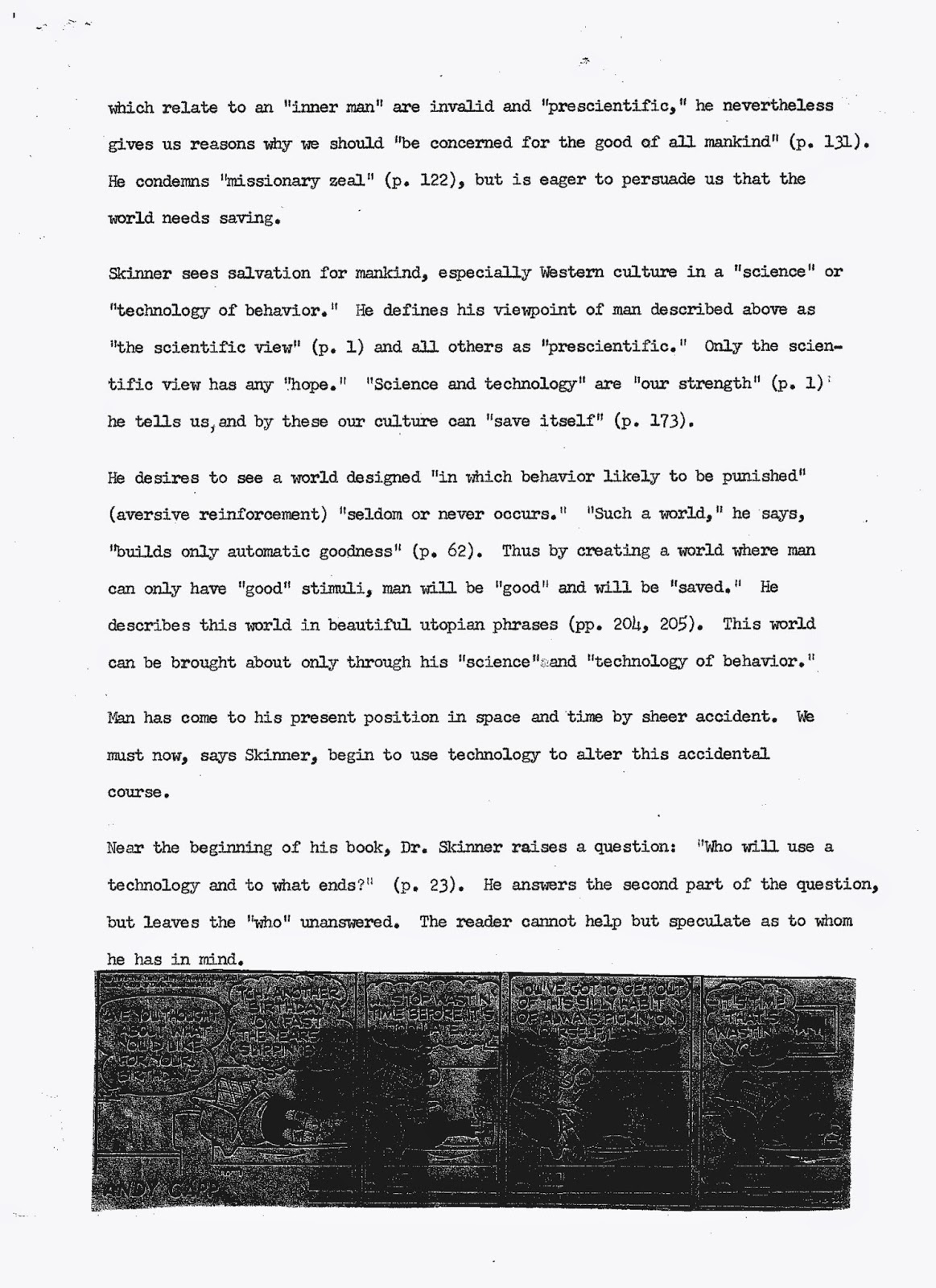
I have reproduced my 40-year-old brief paper here (typed by Uni on her Royal electric typewriter) for those who may be interested in where dehumanizing thinking can lead.
 

Thursday, April 24, 2014

RAMBLINGS ON TECHNOLOGY AND BIBLICAL ETHICS

I received the following comments and question after my post:  THE TITLE OF MY BLOG.  "... this has been kicking around in my mind for a while and kind of relates to your last post.  Do you feel like you can always find answers in the Bible?  I am thinking about some of the rather bizarre cases that come before the Supreme Court.  Something like parental rights in cases with surrogate mothers.  Usually things that come up as a result of technology.  I sometimes hear about these cases and I think that I don’t have any idea on how to even form an opinion.  It seems that technology is beginning to blur some lines that used to be distinct, yet while technology races ahead our thinking does not keep pace.  Anyway, I am interested in any thoughts you wish to share."

Well, I'm not sure where to start with this, but I'll give it a shot.

The first thought that came to mind was of a former neighbor of ours.  When we first met her, she and her husband had 3 lovely children and she showed signs of being pregnant again.  One day when Uni was baby-sitting, their oldest, an 11 year old daughter, said something about her Mom's condition.  When Uni cautiously questioned her, the little girl said something like, "Yes, Mom's pregnant again - but it's not ours."  Later we found that our petite little neighbor lady was on her 5th pregnancy; she'd had one before that was "not hers" and the present pregnancy was twins.  She was simply providing the womb for the fertilized egg supplied by others.

This, of course, was our first exposure to surrogate motherhood and it, of course, caused us to begin to think through what our position should be - or if we even should have a position.  Our neighbor had no problems or questions about "parental rights"; she saw what she was doing as a ministry to a couple in need.  As a matter of fact, she and her family became friends with the two couples she had carried babies for and even visits with them and their children.

Of course, the Bible also has a story of a "surrogate mother" of a different sort; her story is told in Genesis, chapter 16 and the following chapters.  It is the tragic tale of Hagar and her son Ishmael.  This one did stir up questions of "parental rights."

Abram, the patriarch, had been called of God to, among other things, establish a progeny through whom "... all families of the earth will be blessed" (12:3).  One problem:  Abram's wife Sarai was sterile (11:30).  So Sarai suggested to Abram that he impregnate her young Egyptian slave girl.  (We, of course, don't read that Abram was resistant to the idea of sleeping with the maid.)  Sarai, however, had second thoughts and ran off the pregnant Hagar.  Later, however, we find Abram still longing for his son Ishmael (17:18).  The real problem with this story is that, like so many in the Bible, no moral is clearly drawn; there are no neat principles to guide future generations.

But the above stories do little to increase our understanding of complex moral issues such as mentioned in the correspondence above.  So back to the question:  do I feel like I can always find answers in the Bible?  I'll give a clear yes and no to that one!

There are many matters for which there are no clear answers in the Bible.  The Book was written over a 1,500 year period in and to an ancient culture that greatly differed from that of today.  And even in its own day, it undoubtedly left many ethical questions unaddressed.  I believe that attempts to answer current questions by simply pulling isolated verses out of their contexts for "proof texts" is not only misguided, but also can actually be counterproductive - even dangerous.

On the other hand, there are many clear moral imperatives in the New Testament, some of which are quite specific.  And even more than this, there are broad commands, which while not necessarily specific to a particular case, contain principles which can be specifically applied in many instances, such as love for one's neighbor, the value of human life, care for the poor and stranger, etc.  That's why I believe the Christian needs to read his Bible, seek to interpret it correctly, to "think theologically" and to attempt to apply these principles in contemporary situations.

Supreme Court cases, like the one mentioned above, would be extremely difficult.  Another that is currently awaiting decision, is the case of Hobby Lobby and the company's refusal to pay for "morning after" pills or IUDs in their health care program.  These cases involve not only ethical/moral issues; but also matters of constitutional interpretation.  Though the Court is supposed to be apolitical, somehow decisions such as these usually end up 5/4 along conservative/liberal political lines.  And whether we form an opinion on these matters would seem to have no effect on the justices' decisions.

I agree that "technology is beginning to blur some lines that used to be distinct."  Humankind is capable of doing many things that at one time were felt to be only the province of God.  However, advances have been going on for hundreds of years, even though they seem to be increasing exponentially at present.  And along the way, it seems there have always been alarming warnings that we are "playing God."  Many - myself included - would like to see technology slow down a bit to let ethics catch up, but that is not likely.

I also fear that "can" has become synonymous with "should."  In other words, the fact that we are capable of doing something is felt to necessitate doing it.

As I stated, I may form opinions on many of these matters, but my opinions will have no effect on the Supreme Court.  And it will have no effect on those who are seeking and accomplishing scientific/technological breakthroughs.  So where does this put me as a Christian?  Where does this put us, the Church?

This is where Romans 12:2 comes into play:  "Stop being conformed to this age, but be transformed by the renewing of your mind."

Our responsibility is to be "renewing our mind" as the passage says.  This involves a constant process of study of the Scriptures, allowing them to "transform" us and to develop thought patterns in conformity with them which help us to think critically about the thinking of "this age."  As Paul says elsewhere:  "...bringing every thought captive to the obedience of Christ" (2 Corinthians 10:5).

There are and will continue to be, matters where it is difficult to form opinions.  I believe we should be continually in the process of forming and re-forming our opinions based on our growth in knowledge, not only of the Scriptures, but also of what is going on in the culture around us.  It is our responsibility as followers of Jesus, to bring our thoughts into conformity with those Scriptures. But we are not directly responsible for the thinking and actions, right or wrong, of those of the culture around us, even though I believe we are responsible for influencing our culture for what is right.

So if I (or some believer in my sphere of influence) am confronted with the need for a personal decision in these areas, I will have to be as clear in my thinking as possible.  And if I am unable to see clearly to decide, I should admit my ignorance while still seeking for answers.

          TAKING A STAND
          FURTHER THOUGHTS ON TAKING A STAND

Tuesday, April 15, 2014

THE TITLE OF MY BLOG

When my first blog post was published, the blog was given the title "Bill's Thoughts," for want of something better, I suppose.  Later, when our daughter Sherry helped to give the blog a new look, she suggested that I expand the title and be more specific about what I was thinking of.  So I added the subtitle "on the Bible, Theology and American Culture," which narrowed the field a bit.

But why this title?  I suppose because I didn't want it to be considered as just about me.  And besides, by this time I could see that this was a pretty accurate description of the content of the blog.  And I feel that for a follower of Jesus Christ, these should be major topics of thought.  These three should, in fact, occupy the thinking of every follower of Jesus.

The Bible is our source of knowledge about God.  Although "The heavens declare the glory of God and the sky proclaims the work of His hands" (Psalm 19:1) and though "Since the creation of the world, His unseen attributes are clearly seen, being understood through what He's made - that is, His eternal power and divine nature" (Romans 1:20), yet we need to know more.  We need specific knowledge of who God is and of His plan for this world, especially His redeeming plan for humankind.  We need this Book as well, to understand His standards and principles for living.  We need to read and think on this Book!

Theology is what we do with the material we find in the Bible.  It's a necessary part of how the follower of Jesus thinks.  Everyone has a theology - even those who don't believe.  We all have a system of thought about God and His works.  It may be inconsistent, even self-contradictory.  Hence the necessity for "thinking theologically," for taking the truths about God that we gather from the Bible (and elsewhere) and arranging them in a consistent pattern or system.  This, like our study of the Bible, is for the Christian, a lifetime process.

And this is why my thoughts on the Bible and theology fill many of the posts on this blog.  At times I write out these thoughts to clarify my own thinking.  At other times I write to interact with the thoughts of others that I have read or heard elsewhere.  And I also write as a teacher, both to inform others, and even more, to attempt to stir my readers into thinking through, or rethinking, their ideas and opinions,

The third term in my subtitle is "American Culture."  Perhaps I need to define my terms here.  The world "culture" is related to the word "cultivate," which anyone who has worked on a farm or tilled a garden understands.  Webster's 11th Collegiate Dictionary gives a number of definitions, of which the following are relevant to my usage:
          2:  the act of developing the intellectual and moral faculties, esp. by education
          5a:  the integrated pattern of human knowledge, belief, and behavior that depends upon the capacity for learning and transmitting knowledge to succeeding generations
          5b:  the customary beliefs, social forms, and material traits of a racial, religious, or social group; also:  the characteristic features of everyday existence (as diversions or a way of life) shared by people in a place or time

So when I use the term "American culture," I'm using it in the sense of definition 5b, "the customary beliefs, etc. ..." shared by Americans.  Of course, I recognize that not all of the 300+ million Americans hold to the same exact culture, but I believe I can say that there are many beliefs, etc. shared in common.  I, of course, speak often in generalities and at other times narrow my focus to particular subgroups.

My concern in thinking and writing about American culture is not simply to comment or give opinion on it, or on certain aspects of it.  My concern is that as a Christian I must relate to American or any other culture from a biblical perspective.  I strongly believe and fear that many Christians today are ignorant, not only of the Bible, not only of theology, but also of how their Christianity is to relate to the culture around them.

I can't find an exact biblical word that could be translated by the word "culture," but the New Testament authors do have some words that come close.

The Apostle Paul usually uses the Greek words aion touto, usually translated "this age."  He speaks of "the wisdom of this age" and "the rulers of this age" (1 Corinthians 2:6).  The word is usually used of the thinking and actions characteristic of the present period of time, preceding the return of Christ.  Paul even says that Christ "... gave Himself for our sins, in order to deliver us from the present evil age" (Galatians 1:4).  I don't believe that Paul is claiming that every aspect of our culture is "evil" but that the culture that characterizes this age is amoral.

I believe that American culture, like all other cultures is essentially amoral, though there are aspects of this or any other that are definitely immoral by the standards of the Bible.  It is our responsibility to recognize those aspects for what they are and to adjust our thinking and behavior accordingly.  This is not a simple task (after 400+ posts, I'm still working on it).

Not only are we in danger of accepting those aspects of American culture which are immoral, there are related, and I believe, greater dangers.  One is that of accepting the beliefs, ideas and behaviors of American culture as equal to biblical beliefs, ideas and behaviors; even greater, as if they were biblical!  But the "American way" is not necessarily God's way!  Even worse, in some cases the American way is even held by some above the biblical standards.

Paul's exhortation in Romans 12:2 is appropriate here:  "Stop being conformed to this age, but be transformed by the renewing of your mind."

My desire then, in writing this blog is to challenge my readers (and myself) to "think theologically," to think through our biblical knowledge and convictions and to examine our cultural presuppositions as to whether they conform with the Scriptures; to let this thinking transform us; to be critics of the culture around us and not mere conformists.

Friday, April 4, 2014

HUNG UP ON SEX?


Sexual behavior and reproduction seem somehow to be always major discussion points in the American conversation, including our religious and political conversation.  The political left and the political right, the religious and the irreligious, all appear to be obsessed with sex, although those of every position (no pun intended) see those they oppose as the ones with the hangups.

Atheists and other nonbelievers seem to believe that Christians and our Bible are full of sexual hangups.  After all, nakedness and shame are mentioned within the first few chapters of the Bible.  And then there are all those restrictive regulations in the Torah about who could and could not have sexual relations with whom.

As a Christian, I must confess that the history of the church is filled with all sorts of bizarre sexual taboos and that there has been a still is a lot of hypocrisy by those of us who say one thing and practice another.  The more rules there are, the more rules will be broken and the more hypocrisy will be practiced.

But are we more hung up than those who criticize us?  I don't believe so.  We see rather a sort of sick obsession with sex on the part of the entertainment media (which by the way, is not controlled by the church).  And in our politics.

The Bible has a lot to say about sex and it isn't negative at all.  And if those who claim to be Bible readers would read it open-mindedly in its context, we'd find that sex is treated approvingly.  After all, as has been said many times, God is not opposed to sex - after all He invented it!

The opening chapter of Genesis treats sexual and reproductive behavior rather matter-of-factly.  The animals are said to reproduce "after their kind."  The original readers understood what this means and any modern day reader raised on a farm understands how this occurs.  Then when God creates humankind, He tells them, among other things to "multiply and fill the earth" (Genesis 1:28).  Though some medieval monastics may have imagined that our original ancestors were able to reproduce without sex in their "pre-fall" state, the simplest understanding is that God expected - even commanded - them to have sexual relations.

In the account in Genesis 2, God says that a man is to "cleave to his wife, and they will become one flesh" (verse 24).  This of course involves sexual union.  The Apostle Paul seemed to take it this way in 1 Corinthians 6:16.  The author of Genesis even tells us that "the man and his wife were both naked and were not ashamed" (2:25).

The shame does not enter until the Fall (Genesis 3), after the man and the woman have disobeyed God.  It is then they discover their nakedness.  Their attempts to cover themselves were attempts at dealing with their recognition of who they now were and what they had done.  There is nothing in the text that even hints that either their sin or their cover-up have anything to do with sex.  Even the statement that Eve would have pain in childbirth is not tied to any sexual problems.  Like the ground, fruit-bearing was from this point on going to involve pain (Genesis 3:16, 17).

We could go on and on.  We read, "Adam knew his wife ..." (4:2, 35).  Sexual activity is spoken of as being totally natural.  Men are continually "knowing" their wives" and "begetting" even down to Joseph and Mary, after Jesus' birth (Matthew 1:25 - "he didn't know her until she gave birth to a Son.")

The regulations on sexual activity given in the Mosaic Law are not given to ruin sexual pleasure but to restrict it to the marriage relationship.

But God didn't give us sex only for reproductive purposes.  He gave it for pleasure as well.  And (speaking as one who is long past the reproductive stage) that pleasure was not given simply as a sort of "perk" to get us to have more babies; that pleasure continues long past the child-bearing age.  In fact, no longer having to consider pregnancy as a possibility can increase that pleasure.  In Proverbs 5:18, 19, men are exhorted to enjoy sex with their spouse.

          "Let your fountain be blessed, and enjoy the wife of your youth;
          A loving doe, a graceful deer, let her breasts satisfy you at all times;
          Get drunk on her love continually."

This is pretty spicy stuff!  Of course, some will object that it is only part of a larger passage on marital fidelity (Proverbs 5:15-23).  But sexual pleasure with one's spouse is presented as the incentive to faithfulness.  Paul echoes that concept in 1 Corinthians 7:5, 7.

Even more than this, there is an entire book in the Bible devoted to erotic love - the Song of Solomon.  It's true that down through the years, both Christians and Jewish prudish scholars have attempted to make this poem into an allegory of Christ's relationship with the Church or the LORD's relationship with Israel.  I believe that interpretation is simply due to their sexual hangups; there's no evidence in the text for this interpretation.  However, even if this could be shown to be an allegory, we would then be confronted with a God who loves His people with an erotic passion!

Look at just one of the passages from this poem:

He:     "A garden locked is my sister, my bride,
          A locked fountain, a sealed spring" (4:12).
She:   "Awake north wind, and come south wind ...
          Let my beloved come into his garden
          and enjoy its delicious fruits" (4:16).
He:     "I've come into my garden my sister, my bride,
          I've gathered my myrrh and spices
          I've eaten my honey and honeycomb
          I've drunk my wine and my milk" (5:1a).
Chorus:        "Eat, lovers and drink.  Get drunk, lovers!" (5:1b)

If anyone cannot understand the metaphorical language, he or she has my sympathy!

And so, to my unbelieving friends and readers:  don't judge God or the Bible based on real or imagined hangups of some believers.  Check it out yourself.

And to my believing friends and readers:  if you have sexual hangups, please recognize that you have a God who approves of sex - not only for reproduction but for pleasure with your spouse.

Thursday, December 12, 2013

THE GOLDEN RULE

"And just as you want people to do to you, do to them in the same way" (Luke 6:31).
 
“Everything then, whatever you want people to do to you, in the same way also do to them; for this is the Law and the Prophets” (Matthew 7:12).
 
Just about everyone seems to have some knowledge of the verse in the Bible known as the Golden Rule found in Jesus' Sermon On The Mount.
 
We have two different versions of this rule, which differ slightly.  When we remember that Jesus was most likely speaking in Aramaic, while Matthew and Luke have given it to us in Greek, and that both give us condensed versions of the Sermon, the differences can be easily accounted for.  The real difficulty is that Luke places it early in the Sermon, tucked into a longer passage on love, while Matthew places it much later, separating it from other sayings.

Why is this?  I believe that the simplest answer is that Jesus said it twice.  Most preachers (myself included) repeat themselves in the same sermon, so why couldn't He?  The first time it's spoken (Luke 6:31), it is tucked away within Jesus' commands regarding loving our enemies.  The second time was nearer to His closing remarks.

Most people could probably recite the Golden Rule in one form or another, or at least paraphrase it.  It also seems to be the verse most often deliberately misquoted:
·       “Do unto others what they do unto you.”
·       “Do unto others before they do unto you.”
·       Or (my personal favorite) simply:  “Do others!”

The saying (sometimes referred to as the ethic of reciprocity) is so familiar to Christians who know that it’s a quote from Jesus, that they are often surprised to find that this concept is also found in many religions and cultures.  A Google search will quickly show many similar sayings in Buddhism, Baha’i, Hinduism, Islam and Judaism, as well as in many ancient writings much older that the Gospels.  A few samples:
  • Buddhism:    
    • "...a state that is not pleasing or delightful to me, how could I inflict that upon another?" Samyutta NIkaya v. 353
    • Hurt not others in ways that you yourself would find hurtful." Udana-Varga 5:18
  • Confucianism:
    • "Do not do to others what you do not want them to do to you" Analects 15:23
    • "Tse-kung asked, 'Is there one word that can serve as a principle of conduct for life?' Confucius replied, 'It is the word 'shu' -- reciprocity. Do not impose on others what you yourself do not desire.'" Doctrine of the Mean 13.3
  • Hinduism:   This is the sum of duty: do not do to others what would cause pain if done to you. Mahabharata 5:1517
  • Islam: "None of you [truly] believes until he wishes for his brother what he wishes for himself." Number 13 of Imam "Al-Nawawi's Forty Hadiths." 3
  • Judaism: 
    • "What is hateful to you, do not to your fellow man. This is the law: all the rest is commentary." Talmud, Shabbat 31a
    • "And what you hate, do not do to anyone." Tobit 4:15 4
 
Theologically liberal Christians gladly receive this information as evidence that all religions are equal.  Theologically conservative Christians are sometimes rattled or upset, feeling that this sort of thinking is a threat to the uniqueness of Jesus.
 
But is it?  Does finding truth in other religions threaten the uniqueness of Jesus?
 
No way!
  • First of all we need to realize that not everything Jesus said was original with Him.  Every word He said was and is true, not because it was all original with Him, but because He is God.
  • Secondly the doctrine of natural revelation teaches us that God has revealed Himself in many ways.  “…that which is known of God is evident among them (humankind), for God made it evident to them” (Romans 1:19).  “For whenever gentiles, those not having the Law, do by nature the things of the Law, these, though not having the Law are a law to themselves, such ones as show the work of the Law written in their hearts…” (2:14, 15).
 
But Jesus’ statement is unique for a number of reasons.  The first reason is that it is the word of the Son of God and as such has an authority over His hearers that the other sayings do not.  Also, many (though not all) of the other sayings were in a negative form (“Do not…”), whereas Jesus’ was in a positive form.

Many of the other sayings were stated or could be interpreted with a utilitarian motive, i.e., be nice to others, so that they will be nice to you.  Jesus gives a different reason for this behavior, “…for this is the Law and the Prophets.”  This, I believe, is the radical difference.
 
Jesus’ hearers were mostly Jews, living under the Old Testament Law of Moses.  In Matthew's Gospel we read that Jesus had already devoted a large portion of this sermon to the proper understanding of that Law (5:17-48).  He taught that God’s Law is not simply about the performance or non-performance of external acts, but began with the thought life.  Much of that teaching was in a negative fashion.  Here, in this one statement, He gives a positive summation of the keeping of the Law, as well as the teachings of the Old Testament prophets.
 
Later, when Jesus is questioned by a Pharisaic law expert (Matthew 22:34-36; Mark 12:28) as to which is the greatest commandment in the Law, Jesus replied, “’You will love the Lord your God with all your heart and with all your soul and with all your mind.’  This is the first and great commandment.  And the second is like it, ‘You will love your neighbor as yourself.’  On these two commandments hang all the Law and the Prophets” (Matthew 22:37-40; Mark 12:29-31).
 
Jesus here was quoting from two texts in the Mosaic Law, Deuteronomy 6:5 and Leviticus 19:18b.  And He ties these two together as a summation of the Law and the Prophets.  Jesus quoted these passages a number of times, but sometimes only the second, Leviticus 19:18b, about loving one’s neighbor.
 
I would even venture to say that when He placed the two love commands together, He was implying a link between them – an unbreakable link.  Can one actually love his neighbor without loving God?  Can a person love God without loving His neighbor?
 
And if the “Golden Rule” and the Law of Love are both said to be the fulfillment of God’s Law, can we not assume that they are one and the same?  This elevates the Rule to more than a utilitarian social ethic.  Though it may be found to be good practical advice, it is so much more than that.  It is an expression of the Love of God worked out in our lives.  As John, one of Jesus’ 12 disciples, would later write, “We love because He first loved us” (1 John 4:19).
 
The other disciples also grasped this concept.  James, Jesus’ brother, who was not a believer at the time Jesus preached the Sermon, but may very well have heard it, wrote of it in his letter, referring to it as “the perfect Law, the Law of Liberty” (James 1:25) and “the Royal Law” (2:8).
 
And then there’s Paul, another who was an unbeliever at the time of the Sermon, who probably never heard Jesus at all, and who many believe wrote before the Gospels were written.  Yet he grasps Jesus’ sayings and almost paraphrases Him.
 
“For all the Law is fulfilled in one word in this, ‘You will love your neighbor as yourself’” (Galatians 5:14).
 
“Owe nothing to anyone except to love one another, for the one who loves the other has fulfilled the Law.  For this, ‘You will not commit adultery, you will not murder, you will not steal, you will not covet,’ and if there’s any other commandment, it is summed up in this word, ‘You will love your neighbor as yourself.’  Love does not do evil to a neighbor, therefore love is the Law’s fulfillment!’” (Romans 13:8-10).
 
So for the follower of Jesus, the “Golden Rule” is more than just good advice, more than the best advice.  It is the living out of the love of Christ in our relationships with others.
 
{NOTE:  Most of the above thoughts were previously posted on THE SERMON ON THE MOUNT, 20.}